Urban Mobility Forum (CUTQ) – Second Quarter 2023
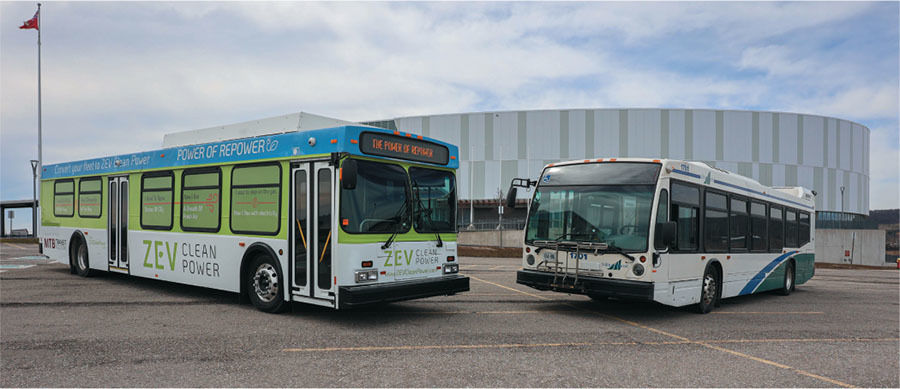
A Canadian First, Milton Transit Diesel Bus Being Converted to Electric Power
What if conversion is a better way to a greener fleet?
NESTLED IN THE shadow of the Niagara Escarpment, the Town of Milton is a family friendly community known for its proximity to nature, vistas from the top of craggy Rattlesnake Point, and the all-weather cycling offered by its world-class velodrome.
Sustainability is top of mind in Milton, which declared a Climate Emergency in 2019 and continues its work to address climate change. Like many municipalities in Canada, Milton Transit is busy preparing for a zero-emission transit system.
But Milton is turning heads because of the route it’s exploring to get there.
A NEW WAY FORWARD
This spring, the Town announced that it is collaborating with Milton-based MTB Transit Solutions on Canada’s first mid-life conversion of a diesel bus to a battery electric propulsion system. The pilot explores the innovative idea that a diesel-to-electric conversion could offer transit systems a speedy, affordable path to full electrification.
"Exploring transit electrification represents Milton’s focus on making our community more attractive and competitive," said Milton Mayor Gord Krantz. "This exciting partnership will help us learn about ways to address climate change and greenhouse gas emissions."
An electric bus conversion has an interesting business case. It’s not something you would consider for a personal vehicle. But transit buses typically last about 12 years. They need servicing and engine overhauls like any hard-working diesel vehicle. We also live in an era of complex supply chains, fierce global competition for new EVs, and price tags for new electric buses approaching $1.5 million.
"The transit industry around the world is starting to shift from diesel propulsion to cleaner sources of energy," said Gara Hay, President, MTB Transit Solutions based in Milton. "We are thrilled to work with the Town of Milton on this Canadian first, and to demonstrate how transit systems can reduce their greenhouse gases."
CANADIAN TECHNOLOGY
Through its new technology, ZEV Clean Power, MTB will work for six months to convert a conventional 12-metre Milton Transit bus to battery electric power. MTB developed the ZEV Clean Power initiative with support from the National Research Council of Canada – Industrial Re-search Assistance Program (NRC IRAP), with research/development support from the Innovative Vehicle Institute (IVI) and participating Canadian post-secondary institutions.
Imagine mechanics in the expansive MTB garage surgically removing all the diesel components and replacing them with smaller and cleaner options: a quiet electric motor that never needs an oil change, batteries installed in place of the radiator, in-bus telematics to track battery performance, and much more.
LESSONS TO LEARN
Because each Milton Transit bus averages about 72,000 km a year, MTB estimates that the conversion could save about 51,260 kg of diesel emissions over six years. The pilot will monitor actual emissions, among its many KPIs. The project cost of $882,000 includes conversion and delivery of the vehicle, all vehicle components, charging infrastructure, warranty, and training.
"As we embrace sustainability, we want to make evidence-informed decisions that will yield results over the long term," said Kristene Scott, Commissioner of Community Services, at the Town of Milton.
The Town is also doing a Milton Transit Battery Electric Bus Feasibility Study and Transition Plan. This will provide a road map for the implementation of electric buses and charging infrastructure.
The pilot will explore and evaluate a range of factors, including technology capabilities, limitations, service delivery implications, maintenance, and lifecycle costing. The project’s goals are to:
Learn about what is required for mid-life diesel-to-electric refurbishment as a way to embrace battery-electric buses (BEBs) at Milton Transit.
Measure the reduction of greenhouse gas emissions.
See how the vehicle performs in Milton’s climate and topography.
Learn about BEB operation, costs, maintenance and charging infrastructure.
Collect public, operator and maintenance feedback to understand challenges and perceptions about BEBs.
Understand how BEBs will affect scheduling in a transit service.
Align with the Town’s sustainability and climate change goals, reducing reliance of fossil fuels.
"This pilot will help us learn about diesel-to-electric bus conversion technology and make the best decisions in our move toward an electric transit fleet," Scott added.
The project is so unique that the Town is documenting each step of the conversion on its website: removing the engine, wiring the batteries, installing the charger, road testing, and more. The converted bus is expected to hit the road in early 2024.
Follow the journey and see more photos at www.milton.ca/electricbus.
See original article.

